The Best Crystals for Protection: What Practitioners Actually Reach For
From black tourmaline to labradorite, certain stones have been carried for protection across centuries and cultures. Here's what practitioners actually choose, and how they use them.
Soldiers pressed hematite against their skin before battle. Tibetan monks strung Dzi beads as centerpiece talismans on their malas. Roman merchants slipped agate amulets into their cloaks before long journeys. People have always reached for stone.
The reasons are practical as much as symbolic. A stone in the pocket is a physical reminder to stay grounded. It asks something of your attention every time you touch it. And in traditions ranging from Tibetan Buddhism to Scottish Highland lore, specific stones have accumulated centuries of association with steadiness, clarity, and protection from harm.
None of this replaces discernment, professional support, or common sense. But for many people, a well-chosen protective stone offers something quieter and more durable: an anchor for awareness.
Why Some Stones Have Always Been Carried for Protection
The cross-cultural record on protective stones is remarkably consistent. In ancient Tibet, etched agate Dzi beads were passed between generations as heirlooms, each pattern carrying a specific protective meaning. Roman soldiers carried hematite into battle, associating the iron-rich stone with physical endurance. Medieval European herbalists tucked smoky quartz alongside their remedies. These weren't identical beliefs, but they shared a logic: certain materials, by their weight, colour, or origin, focused human intention toward safety and resilience.
Modern practitioners draw on this same logic, without necessarily claiming metaphysical certainty. A stone worn daily becomes a ritual object. You put it on deliberately. You feel its weight. That repetition shapes attention in ways that accumulate over time.
The Stones Practitioners Reach For Most
Black Tourmaline
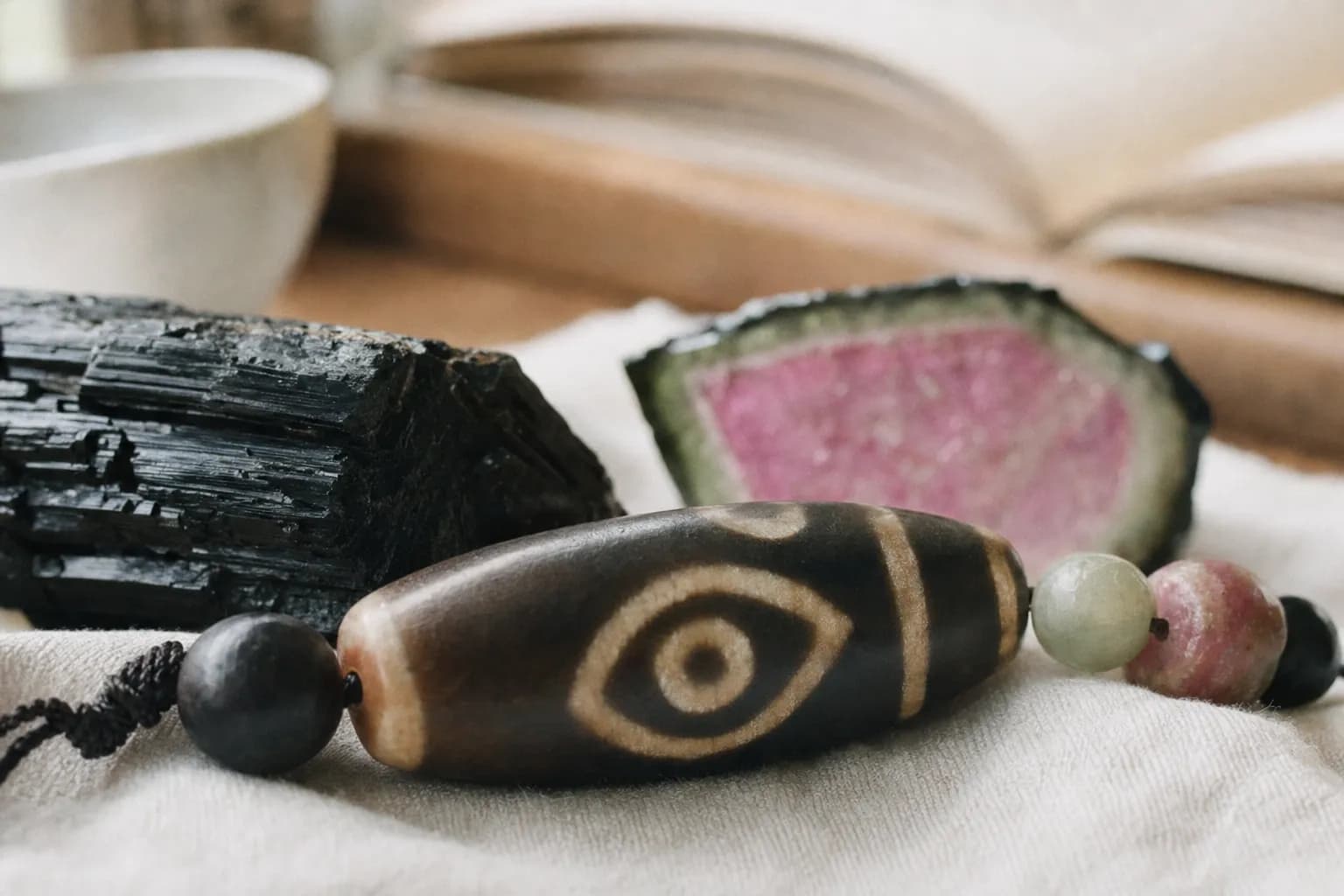
Ask most practitioners which stone they keep closest when they want to feel grounded and protected, and black tourmaline comes up immediately. It's a striated, almost fibrous mineral, dark and dense, with a surface that catches light in narrow ridges. In modern crystal practice, it's associated with energetic boundary-setting: the sense of having a perimeter around yourself that distracting or draining influences can't easily cross.
Many people keep a piece near their front door, slip one into a bag when travelling, or wear it on the left wrist. The weight is noticeable. That's part of the point.
Black Obsidian
Obsidian is volcanic glass, formed when lava cools so quickly that no crystal structure can develop. It's been used as a mirror, a blade, and a talisman across Mesoamerican, Tibetan, and Mediterranean traditions. In Tibetan practice, obsidian mirrors were used to reveal rather than reflect, tools for seeing clearly rather than seeing prettily.
Practitioners tend to describe obsidian as sharper in quality than tourmaline. It's one of the best crystals for protection when what you need isn't just grounding, but honest self-examination alongside it.
Labradorite
Labradorite comes from the Labrador Peninsula in Canada, though it also appears in Finland, where it's been named spectrolite for the full spectrum of colour it throws under light. The Inuit peoples of the region have long associated it with the aurora borealis. Practitioners reach for labradorite when entering unfamiliar environments or navigating significant life changes. Its iridescent flash feels appropriate to that purpose: a stone that reveals different colours depending on how you look at it.
Smoky Quartz
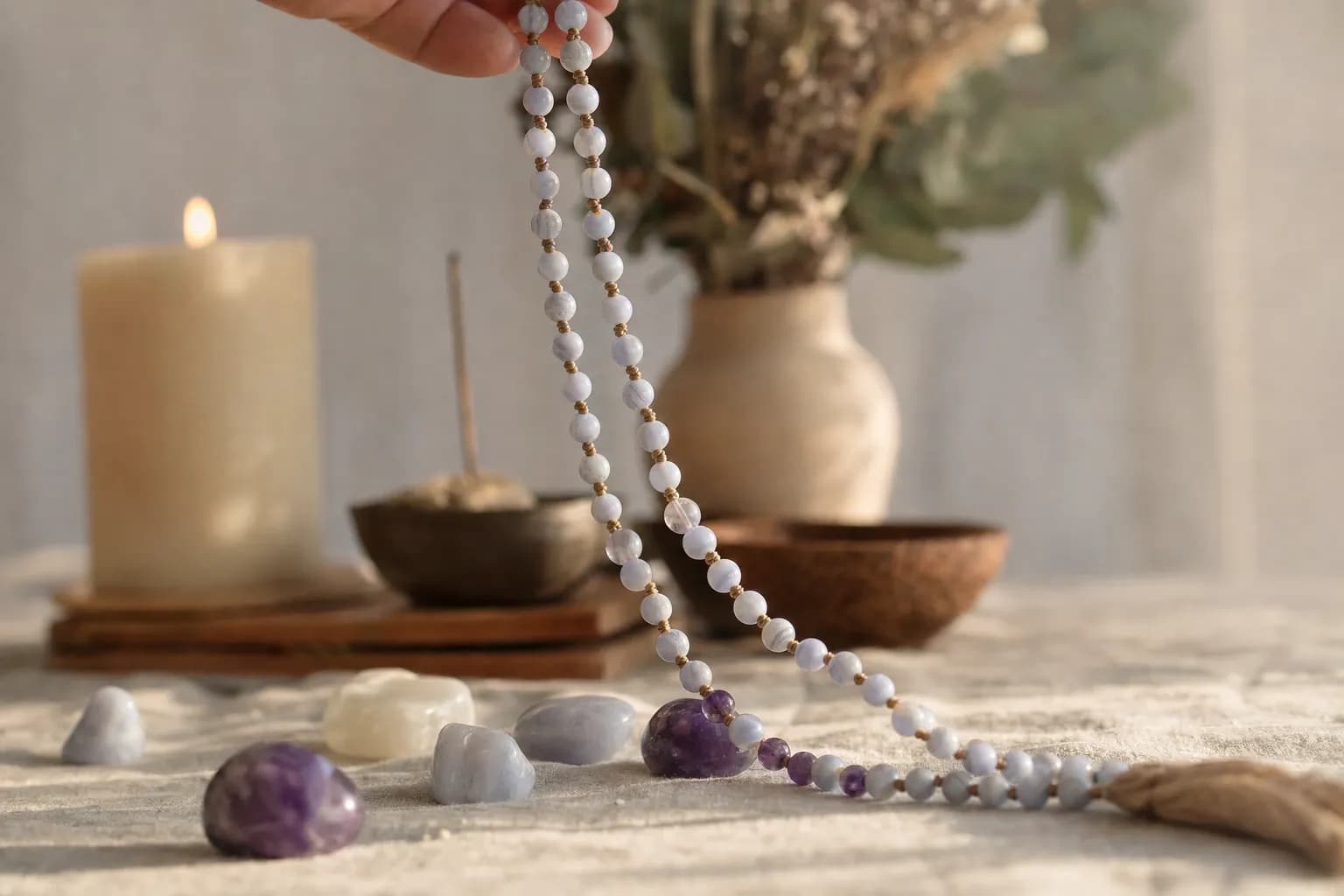
In Scottish Highland tradition, smoky quartz was considered a grounding stone par excellence, used by Cairngorm craftspeople who cut it from the mountains of that name. Its grey-brown translucence gives it a quality of filtered light. Many practitioners wear it to quiet an overactive mind, holding a grounding gemstone between the palms during breath work, or wearing it through long days of concentrated work.
Hematite
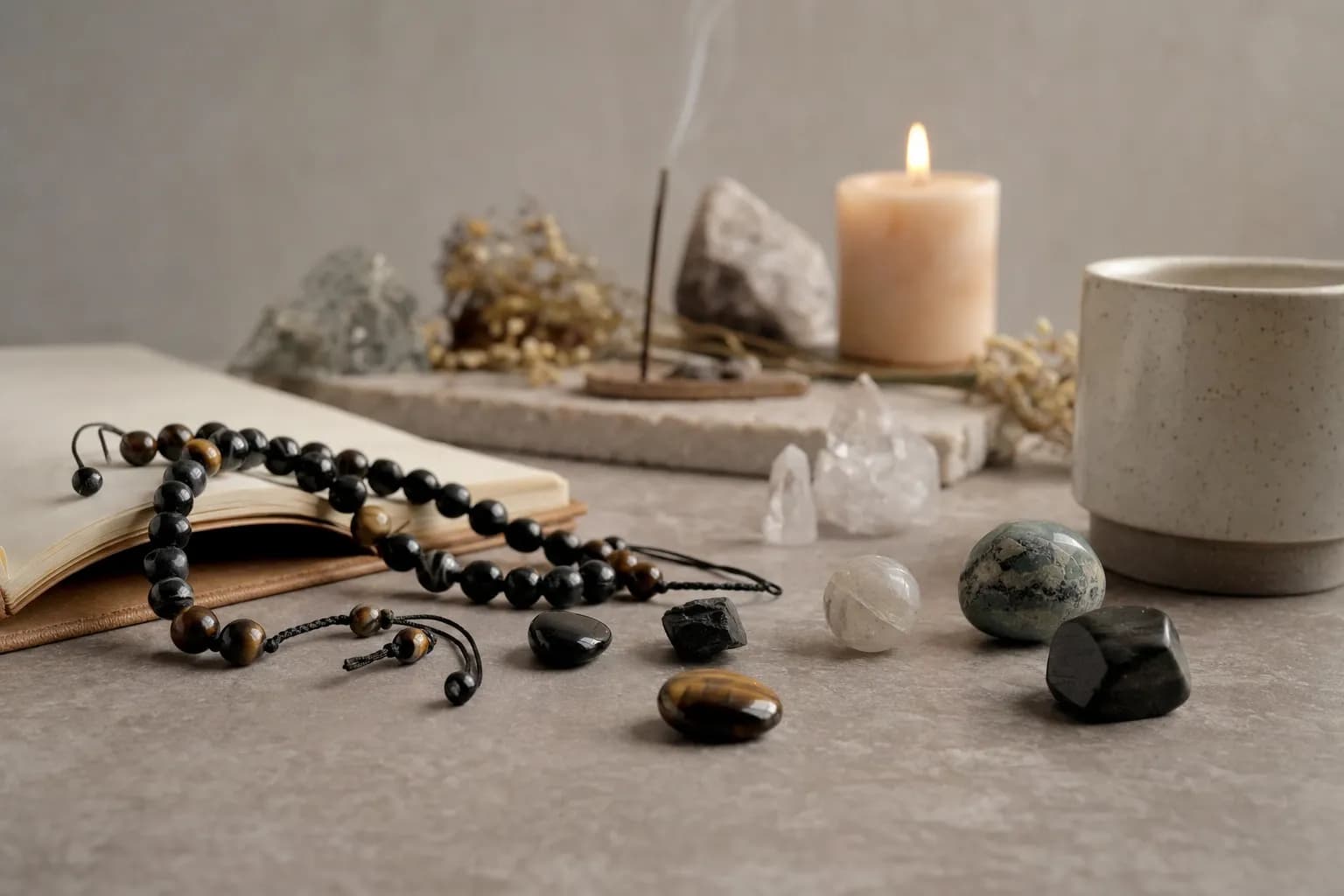
Hematite is iron ore. It's heavy, cold to the touch, and has a metallic lustre that makes it look almost poured rather than grown. Roman soldiers carried it as a protective stone, associating its iron content with physical strength. The sensation of holding hematite is unusually anchoring simply because of its weight. For people who feel unmoored or scattered, that physical density offers something straightforward to come back to.
Tiger Eye
Egyptian amulets carved in the shape of the eye of Ra frequently incorporated tiger eye, a stone whose golden-brown chatoyancy (the shifting band of light along its surface, sometimes called a cat's eye effect) was linked with alert, far-seeing awareness. Practitioners pair it with darker grounding stones to balance earth-bound steadiness with a quality of attentive alertness.
How to Choose the Right Protective Stone for You
The most useful first question is: what kind of protection are you looking for?
- Energetic boundaries: Black tourmaline, obsidian. Dense, dark, associated in practice with maintaining a clear perimeter between your inner state and external noise.
- Grounding during transition: Smoky quartz, labradorite. For periods when change feels disorienting and you need something that holds steady.
- Physical steadiness and focus: Hematite, tiger eye. For days requiring sustained attention and a sense of being squarely in your body.
- Layered protection: Black tourmaline paired with smoky quartz is a common combination. Together, they offer boundary-setting and mental clarity without either overwhelming the other.
Beyond intention, trust your physical response. Pick up a stone. Notice its weight, temperature, and texture. Practitioners across traditions describe a quality of recognition when the right stone is in hand. That instinct, whatever its origin, is worth listening to.
At Ardor Rituals, stone selection for custom bracelets begins with your date of birth, read through Pythagorean numerology (a system that reduces your birth date to single-digit numbers, each associated with specific qualities and compatible stones) and your stated intention. If you'd like that process applied to a protective talisman for your own wrist, you can compose a custom protective talisman at the atelier.
As for wearing: carrying a stone loose in a pocket keeps it close without commitment. Placing one at home, near a door or on a windowsill, makes it part of the environment rather than personal practice. Wearing it on the body, as a bracelet or pendant, brings the most consistent contact.
Wearing Protective Stones: Bracelets, Malas, and Placement
In crystal practice, the left wrist is generally associated with receiving energy, and the right with projecting it. This is a convention of practice, not a universal rule, but it has a practical logic: protective and grounding stones are often worn on the left, so their quality meets you as you move through the day.
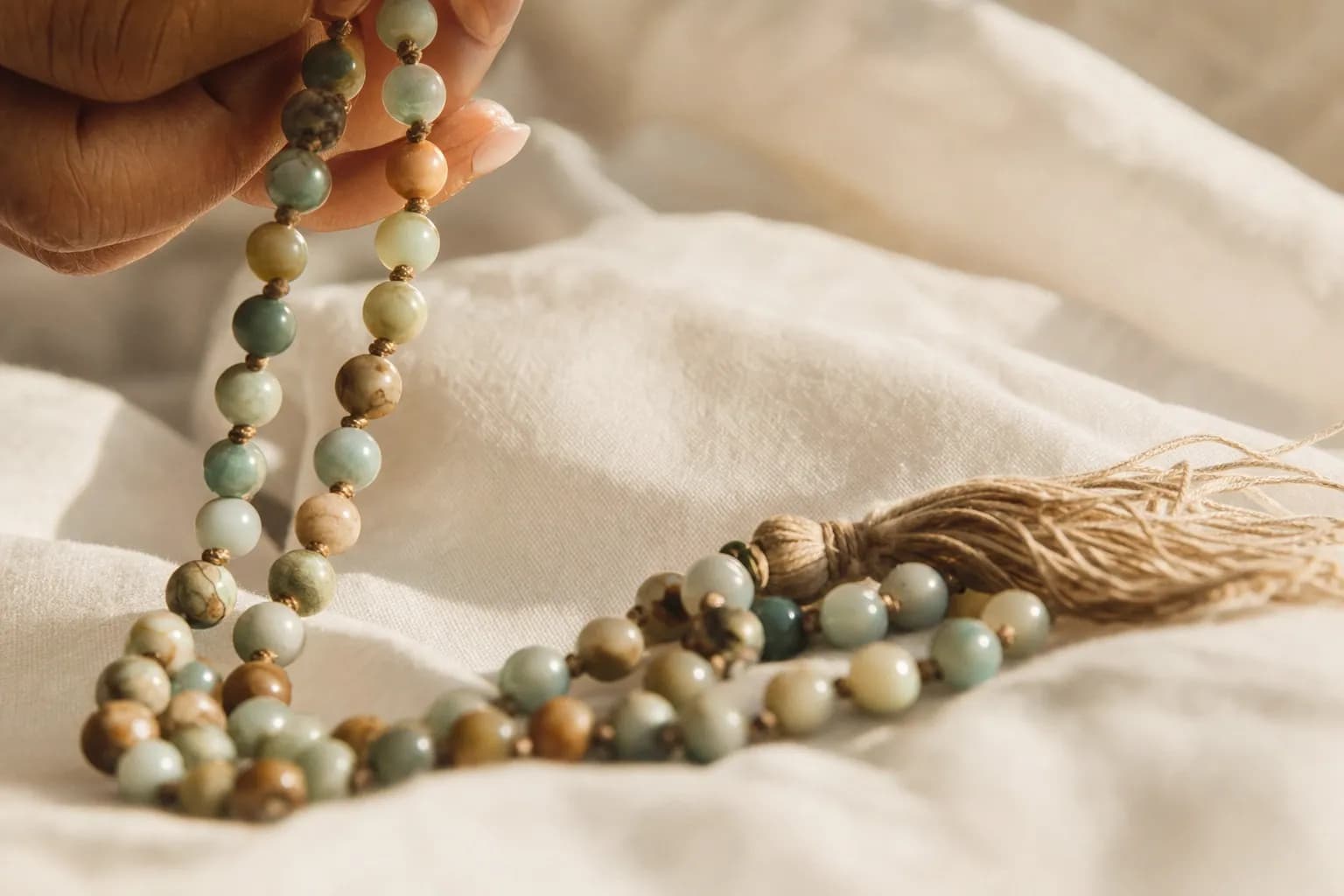
The 108-bead mala has a longer history. In both Tibetan Buddhist and Hindu traditions, the mala is a string of 108 beads used for japa meditation: the practice of repeating a mantra or intention, one repetition per bead, for a full circuit. The number 108 appears across multiple sacred mathematical traditions. A mala worn as a bracelet condenses this into a wearable form, keeping the object of practice on the body.
Tibetan Dzi beads occupy a specific position in this lineage. Etched agate beads, believed in Tibetan tradition to be of divine origin, Dzi were sewn into clothing, strung on malas, and worn as protective centerpiece talismans for over a thousand years. Each pattern carries a distinct meaning: the nine-eyed Dzi, for instance, is associated with merit and fortune. You can read more about the sacred patterns of Tibetan Dzi beads in the journal.
Wearing a protective bracelet consciously begins before you put it on. Hold it for a moment. Name your intention for the day, even silently. That ten-second ritual is what separates a talisman from jewellery.
Cleansing and Caring for Your Protective Stones
Stones accumulate contact. They pass through hands, environments, and moods. Most practitioners cleanse their protective stones regularly, not because stones hold grudges, but because cleansing is itself a ritual of reset: it gives you a moment to reassess your intention and begin fresh.
Salt water is the most common suggestion in popular crystal guides. It's also the most damaging for several stones on this list. Hematite will rust. Polished labradorite and smoky quartz will lose their surface finish. Skip it.
Here's what actually works without risk:
- Moonlight overnight. Leave stones on a windowsill or outdoors on the full moon. Safe for every stone listed here, including labradorite and smoky quartz, which fade under prolonged direct sunlight but handle lunar light without damage.
- Smoke cleansing. Pass the stone through the smoke of dried herbs (rosemary, cedar, and sage are common choices). Brief exposure, not sustained heat.
- Sound. A singing bowl or tuning fork held near the stone. No water, no chemicals, no risk of surface damage.
After cleansing, hold the stone in both hands. State your intention again. This is the moment that matters, the quiet act of recommitment that makes care into ritual.
Frequently Asked Questions
What is the single most recommended crystal for protection?
Black tourmaline is the stone practitioners reach for most often. It's associated with boundary-setting and grounding in many modern crystal traditions, and its dense, striated structure gives it a distinctly heavy, anchoring quality. Carry it in a pocket, wear it on the left wrist, or place it near a front door.
Can I wear more than one protective stone at once?
Yes. Many practitioners layer stones intentionally. Black tourmaline and smoky quartz are a common pairing for grounding, while adding hematite brings a sense of physical weight and steadiness. Keep combinations simple: two or three stones with a clear, shared intention work better than a handful worn without focus.
How often should I cleanse protective crystals?
Most practitioners cleanse protective stones once a month, often on or just after the full moon. If a stone has been through a particularly intense period, or has been handled by others, cleansing it sooner makes sense. Moonlight overnight is the most universally safe method for the stones listed here.
Where should I keep a protective stone at home?
Near entrances is the most common placement. A piece of tourmaline at the front door or on a windowsill is traditional in many modern crystal practices. Smoky quartz near a workspace is used to maintain focus and filter distracting energy. The key is intentional placement, not just decoration.
What is the difference between black tourmaline and black obsidian?
Black tourmaline is a mineral with a striated, almost fibrous structure, associated with grounding and boundary-setting. Black obsidian is volcanic glass, sharper in energy and in tradition, often linked with revealing what is hidden. Tourmaline tends to be the gentler starting point; obsidian suits those comfortable with direct self-reflection.