The Best Crystals for Protection: What Practitioners Actually Reach For
From Brazilian black tourmaline to Tibetan Dzi beads, certain stones have been worn as protective talismans across cultures for centuries. Here's what practitioners actually choose and why.
Why Some Stones Have Always Been Worn as Shields
Roman soldiers pressed engraved onyx seals into signet rings before battle. Tibetan monks tucked agate Dzi beads inside their robes for the road. West African traders strung protective amulets at the wrist long before anyone called it a wellness practice. The specific materials varied by culture; the instinct didn't.
People have worn protective stones across unconnected traditions for thousands of years. That pattern says something worth paying attention to.
None of this is medicine. These stones won't diagnose or treat anything. What they do offer is something older and more honest: a tangible anchor for intention, a physical reminder of how you want to move through the world. That's what the tradition has always been about.
The Stones Practitioners Reach for Most
Black Tourmaline
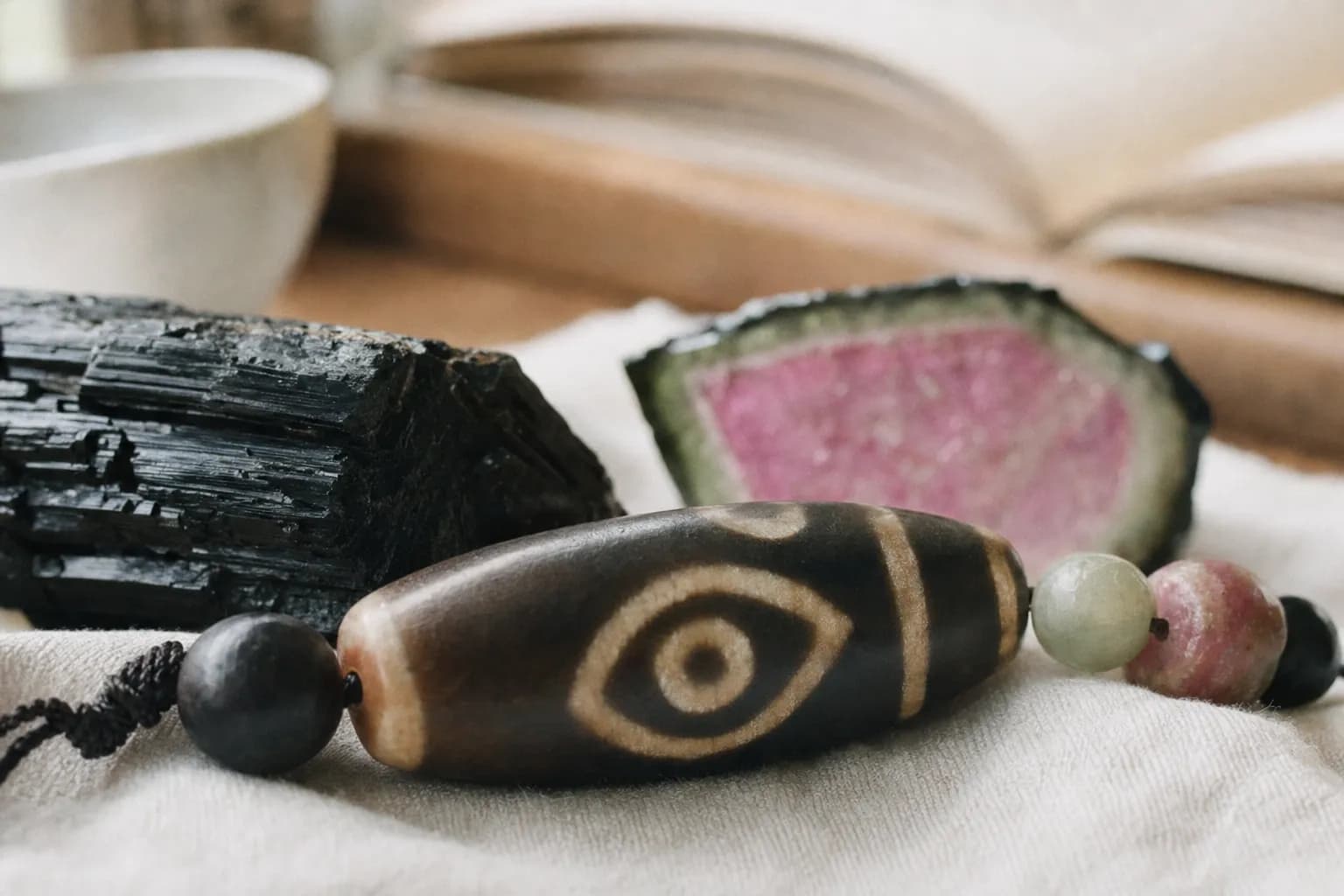
Black tourmaline is the most consistently cited grounding stone in contemporary practice. It grows in striated columns, often mined in Brazil and Pakistan, with a dense, almost metallic-looking black surface. Practitioners wear it when they want a sense of steadiness in high-pressure environments, or when they need something to anchor attention against external noise. It pairs naturally with other protective stones and holds up well to daily wear.
Obsidian
Obsidian is volcanic glass. Literally. When lava cools fast enough, it skips the crystalline structure entirely and forms this smooth, mirror-dark stone. Mesoamerican cultures shaped it into protective ritual objects; Tibetan practitioners wore it as an amulet against unwanted energy. There's no ambiguity about what obsidian looks like: it's glassy, heavy, and deeply black. Practitioners often choose it when they want something with a little more edge than tourmaline.
Labradorite
Labradorite comes mostly from Madagascar and Canada, and it's immediately recognisable by its labradorescence. That flash of blue, gold, and green that appears when light catches the surface at the right angle. Many practitioners wear it specifically as a boundary stone, associating it with a quality of energetic separation between self and environment. It's quieter in appearance than obsidian but arguably more complex.
Black Onyx
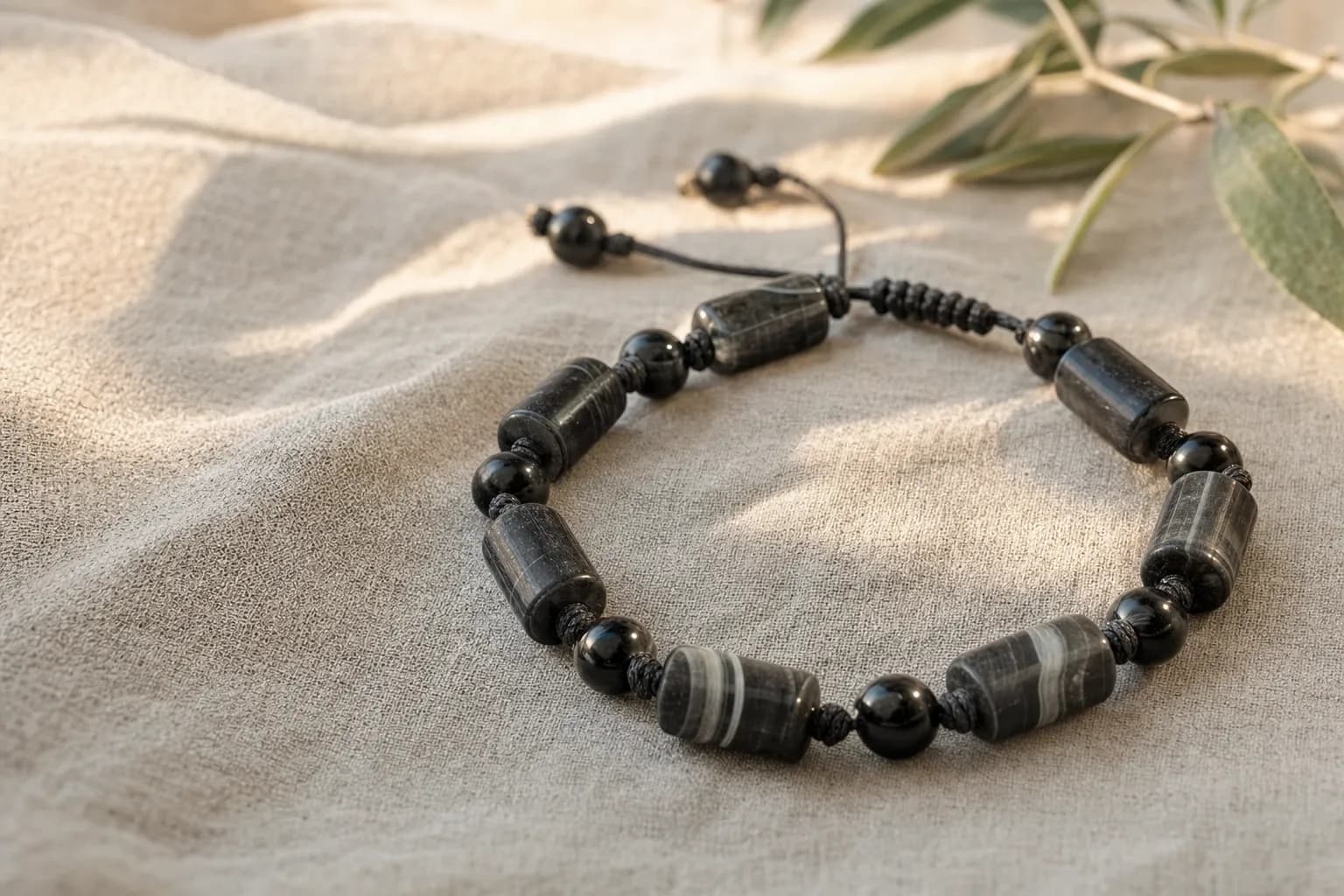
Roman craftsmen carved protective scenes directly into black onyx for intaglio rings, pressing the stone into hot wax to seal documents and ward off harm. The tradition of wearing onyx for steadiness and mental focus has continued across cultures. It's a smooth, matte-to-lustrous black stone, often banded, and one of the most wearable protective stones for everyday use.
Smoky Quartz
Smoky quartz is subtler than the other stones on this list. Its warm, translucent brown-grey comes from natural irradiation of quartz crystal, most notably from deposits in the Scottish Cairngorms and Brazil. Practitioners associate it with clearing dense or heavy energy, often layering it with black tourmaline rather than wearing it alone. Think of it as the quieter companion stone.
The Nine-Eyed Dzi Bead
The Dzi (pronounced "zee") is an etched agate bead from Tibetan tradition, worn for centuries by monks, traders, and Himalayan nobility. The patterns etched onto the bead aren't decorative. Each one carries specific meaning passed down through lineage. In Tibetan tradition, the Dzi bead with nine eye-like markings is associated with protection and the accumulation of merit, a concept roughly translated as the spiritual weight of good action. Authentic pieces are rare and treated as heirlooms rather than accessories. If you want to go deeper on the symbolism, what the Dzi bead patterns mean and how they're chosen covers the full lineage in detail.
How to Wear Protection Stones (and What Actually Matters)
Many practitioners follow the folk tradition of wearing protective stones on the left wrist, based on the idea that the left side is receptive. Drawing in the quality you're working with. Others prefer the dominant wrist, treating it as a way to project intention outward. Both approaches have their practitioners. Neither is wrong. What matters more is consistency and conscious attention when you first put the bracelet on.
You don't need all six stones to build a meaningful practice. A common approach is one primary grounding stone, like black tourmaline, paired with one complementary stone, like smoky quartz for clearing or labradorite for boundary-setting. Adding a Dzi talisman bead as a centrepiece brings a lineage dimension that a single gemstone can't replicate.
Here's how most practitioners begin working with a new protection stone:
- Cleanse the stone before the first wear (see the section below on care).
- Hold it in both hands with your eyes closed.
- State your intention clearly. One short, specific sentence, spoken aloud or silently.
- Take one full breath while holding that intention in mind.
- Put the bracelet on and wear it consistently for at least a week before forming any impressions.
The act of stating an intention isn't ceremony for ceremony's sake. It focuses your attention on the quality you're trying to cultivate. That focus is real, even when the metaphysics are debated.
Caring for Protective Stones
Not every cleansing method suits every stone. Salt water dulls a polished obsidian surface in weeks and can cause micro-fractures over time. Moonlight doesn't damage anything.
A full moon windowsill overnight. Six to eight hours. Is the safest universal method for protective stones. Set the bracelet on a natural surface, away from direct artificial light. That's it. For a more detailed practice around this, the practical guide to cleansing your stones walks through smoke, moonlight, and sound methods in full.
Smoke cleansing works well too. One pass through incense smoke, with the stone held above (not in) the flame. Let it cool before wearing.
For protective stones specifically, cleanse more often than you might with other pieces:
- After a difficult conversation or conflict
- After travel, especially air travel through crowded environments
- After any period that felt draining or unusually heavy
- As a baseline, at each full moon
A black tourmaline bracelet worn daily through a stressful period deserves more attention than one sitting in a drawer. Treat it accordingly.
Choosing the Right Stone for You
The right protective stone depends on what you're actually protecting against. Black tourmaline suits external overwhelm: crowds, difficult people, high-stimulation environments. Smoky quartz works better for internal noise, that restless, scattered quality of mind. Labradorite appeals to people who feel permeable. Who absorb other people's moods easily and want a stone that reminds them of their own edges.
At Ardor Rituals, the atelier uses Pythagorean numerology as one lens for stone selection. Pythagorean numerology is a system that reduces your date of birth to a single core number, which is then mapped to stones with corresponding energetic associations. It's a framework, not a prescription, and it works best alongside your stated intention rather than instead of it.
If you're not sure which stone fits your current season, how practitioners work with protective stones day to day offers more context. Or, if you're ready to build something personal, you can compose your own protective talisman bracelet at the atelier, where stones are selected through your birth number and intention together.
Frequently Asked Questions
What is the most powerful crystal for protection?
Black tourmaline is the stone practitioners cite most consistently. Its dense, striated structure has been associated with grounding and deflecting heavy energy across multiple traditions. Obsidian and the Tibetan nine-eyed Dzi bead are also widely worn for protection. The strongest choice depends on your specific intention. External overwhelm calls for different stones than internal restlessness.
Which wrist should you wear a protection crystal on?
Many practitioners wear protective stones on the left wrist, following the folk tradition that the left side is receptive, drawing in the quality you want. Others wear them on the dominant hand to project intention outward. Both approaches have their place. Consistency and conscious intention when you put the bracelet on matter more than which wrist you choose.
How do you activate or set a protection crystal?
Hold the stone in both hands, close your eyes, and state your intention clearly and simply. Even one quiet breath with a clear mental statement is enough. Most practitioners do this after cleansing a new stone. Naming your intention focuses your attention on the quality you want the stone to companion. That act of focus is what gives the practice its grounding effect.
How often should you cleanse protection crystals?
More often than most other stones, because they're worn specifically to absorb or redirect heavy energy. A monthly full moon cleanse is a common baseline. After a difficult period, travel, or conflict, cleansing sooner is worth it. Moonlight overnight. Six to eight hours on a windowsill. Is the safest method for nearly every stone type, including obsidian and black onyx.
Can you combine multiple protection stones in one bracelet?
Yes, and many practitioners do. A common pairing is black tourmaline with smoky quartz. One for grounding, one for clearing. Adding labradorite for energetic boundary-setting works well as a third element. More than three protective stones in a single bracelet can feel heavy; balancing with a lighter stone like clear quartz or rose quartz keeps the combination wearable.
What is a Dzi bead and how does it offer protection?
A Dzi bead is an etched agate bead from Tibetan tradition, worn as a talisman for centuries by monks, traders, and nobility. The number of eyes etched onto the bead carries specific meaning within that lineage. In Tibetan tradition, the version with nine eye-markings is associated with protection and the accumulation of merit. Authentic Dzi beads are rare and considered heirloom-quality pieces rather than everyday accessories.